
Uttar Pradesh
A region of distinct dialects, rapid growth, and cultural crossroads.

SpeakingArch · CC BY-SA 4.0
Western Uttar Pradesh is a region in India comprising the western districts of Uttar Pradesh, including the Upper Doab, Rohilkhand and Braj areas, where languages like Hindi, Urdu, Braj, and Khadiboli are spoken. The largest city of the region is Ghaziabad, while the second-largest city, Agra, is a major tourist destination. It is in the region of Western Uttar Pradesh that Hindi-Urdu originated. The region has some demographic, economic and cultural patterns that are distinct from other parts of Uttar Pradesh, and more closely resemble those of Haryana and Rajasthan states. Western Uttar Pradesh has experienced rapid economic growth, in a fashion similar to the states of Haryana and Punjab, due to the success of the Green Revolution. A significant part of western Uttar Pradesh is a part of National Capital Region of India.
- population
- 71,217,132
- official language
- Hindi
- additional official language
- Urdu
Verified Timeline
Lore & Background
Western Uttar Pradesh is where Hindi-Urdu originated, with Persian loanwords entering Old Hindi in the area of Delhi and Western Uttar Pradesh, regarded as the predecessor of both languages. The region's Rohillas are descended from immigrant groups from centuries ago, and a large subregion, Rohilkhand, takes its name from that Pashtun tribe. Sikhs from West Punjab, who came from Pakistan after partition, also migrated to the area in large numbers. The region has a history of religious riots happening frequently, including clashes between Hindu and Muslim communities in Muzaffarnagar beginning on 27 August 2013 that claimed 43 lives and injured 93. Another major riot in Meerut took place on 22 May 1987, when 19 personnel of the Provincial Armed Constabulary allegedly rounded up 42 Muslim youth from the Hashimpura mohalla, took them to the outskirts near Murad Nagar, where they were shot and their bodies dumped in water canals. The trial of that case is the oldest pending case at the Tis Hazari complex in Delhi.
Reader's Guide
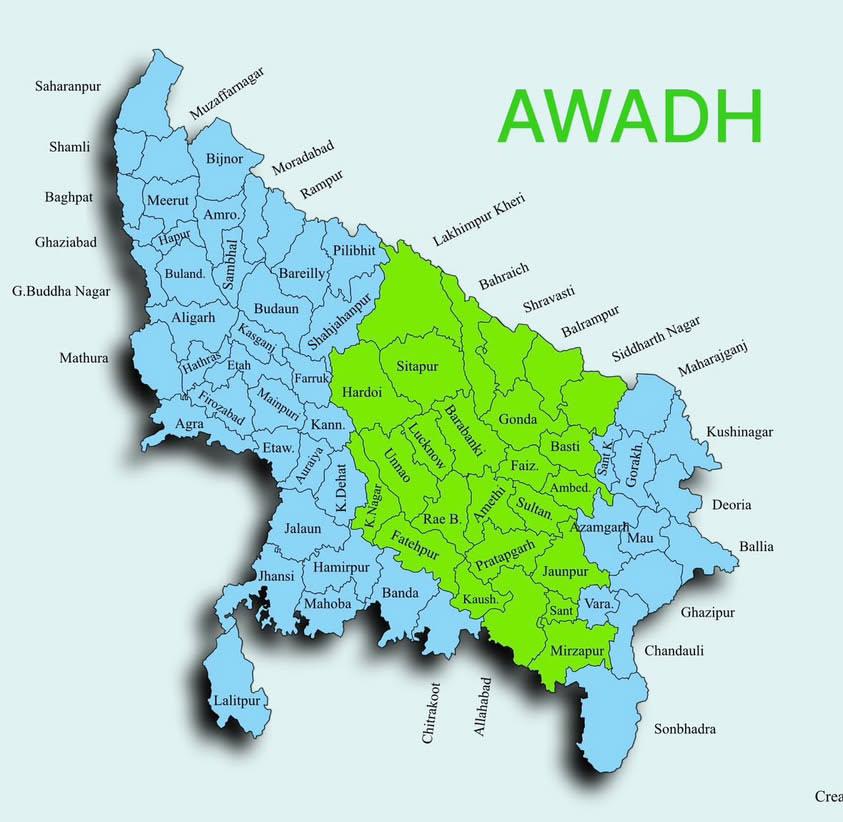
The population of Western Uttar Pradesh is composed of a varied set of communities and tribes, including Ahir (Yadavs), Gurjars, Jats, Brahmins, Meos, Rajputs, Kayasthas, Tyagis, Bhar (Rajbhars), Kachhi, Kahar (Kashyaps), Gadaria, Kumhar, Bania, Khatik, Lodha, Valmikis, Nai, Jatav, Kurmis and Rohilla Pashtuns. As per 2011 Census, the total population is 71,217,132, out of which 72.29% is Hindu and 26.21% is Muslim. The Muslim population share in eight districts has increased from 29.93% in 1951 to 40.43% in 2011. Most people speak Hindi (or its slightly earlier version Khadiboli) and Braj. Khadiboli is spoken in the northern part, including districts like Muzaffarnagar, Saharanpur, Shamli, Bagpat, Ghaziabad, Meerut, Hapur, Amroha, Sambhal, Bijnor, Moradabad, Gautam Buddh Nagar, and Bulandshahar. Braj is spoken in the southern part, including Mathura, Hathras, Agra, Aligarh, Etah, Firozabad, Budaun, Gautam Buddh Nagar, Bulandshahr, Mainpuri, Bareilly and Sambhal. The region receives rain through the Indian Monsoon and the Western Disturbances, with the latter critically important for the main staple, wheat. Major highways include NH 2, NH 3, NH 11, NH 9, NH 58, and expressways like the Yamuna Expressway, Delhi-Meerut Expressway, and Ganga Expressway. Filmmaker Nakul Singh Sawhney founded Chalchitra Abhiyaan, a film and media collective based in Shamli district, after working on his acclaimed documentary Muzaffarnagar Baaqi Hai on the 2013 riots that led to the displacement of over 100,000 people from the sugarcane belt.
Did You Know?
- The region's Rohillas are descended from immigrant Pashtun tribes from centuries ago, and a large subregion, Rohilkhand, takes its name from that tribe.
- The Muslim population share in eight districts of Western Uttar Pradesh increased from 29.93% in 1951 to 40.43% in 2011.
- The 2013 Muzaffarnagar riots claimed 43 lives and injured 93 people.
- The Hashimpura massacre of 1987 involved 42 Muslim youth being shot and dumped in canals; the trial is the oldest pending case at the Tis Hazari complex in Delhi.
- Chalchitra Abhiyaan, a film collective founded by Nakul Singh Sawhney, screens international cinema in rural villages, sometimes live translating films because illiterate villagers cannot read subtitles.
Linguistic Roots and Cultural Distinctiveness
Western Uttar Pradesh is widely recognized as the birthplace of Hindi-Urdu, a linguistic heritage that traces back to the medieval period when Persian loanwords enriched the lexicon of Old Hindi, specifically the Khariboli dialect spoken in the Delhi and surrounding western region. This shared ancestry gave rise to both Hindi and Urdu, which remain the dominant tongues across the area today. Beyond this shared origin, the region is further divided by two distinct dialects: Khadiboli, a slightly earlier form of Hindi spoken in the northern districts from Muzaffarnagar and Saharanpur down through Meerut, Ghaziabad, and Bulandshahar, and Braj, which dominates the southern belt stretching from Mathura and Agra through Aligarh, Bareilly, and Mainpuri. Culturally and economically, Western Uttar Pradesh aligns more closely with neighboring Haryana and Rajasthan than with the eastern half of the state, a fact that has long shaped its identity and political aspirations.
A Mosaic of Communities
The population of Western Uttar Pradesh, recorded at over 71 million in the 2011 Census, is a patchwork of numerous communities and tribes. Among them are Ahir (Yadavs), Gurjars, Jats, Brahmins, Meos, Rajputs, Kayasthas, Tyagis, Bhar (Rajbhars), Kachhi, Kahar (Kashyaps), Gadaria, Kumhar, Bania, Khatik, Lodha, Valmikis, Nai, Jatav, Kurmis, and Rohilla Pashtuns. The Rohillas, in particular, are descendants of Pashtun immigrant groups who arrived centuries ago, and their legacy is so deeply embedded that the subregion of Rohilkhand bears their name. After the 1947 partition, large numbers of Sikh refugees from West Punjab in what is now Pakistan also settled in the area, adding another layer to its demographic fabric. Religiously, the region skews Hindu at 72.29 percent and Muslim at 26.21 percent, a Muslim share notably higher than the state average of 19.3 percent. In eight districts including Saharanpur, Muzaffarnagar, and Meerut, the Muslim proportion climbed from roughly 30 percent in 1951 to over 40 percent by 2011, a shift that has become a recurring flashpoint in local politics.
Economic Rise and the Push for Statehood
The Green Revolution transformed Western Uttar Pradesh into one of India's fastest-growing regions, lifting living standards in a manner that closely mirrors the trajectories of Haryana and Punjab. A significant portion of the region now falls within the National Capital Region, further accelerating its economic integration with Delhi. Ghaziabad stands as the region's largest city, while Agra, the second-largest, draws visitors as a major tourist destination. Yet this prosperity has not been evenly shared across Uttar Pradesh. Eastern Uttar Pradesh, much like Bihar, did not benefit from the agricultural revolution to the same degree, and a deep cultural divide persists, with easterners often lumped together with Biharis in public discourse. These economic and cultural disparities have fueled a sustained demand for separate statehood. Various politicians and parties have proposed names for the prospective state, including Harit Pradesh, Braj Pradesh (reflecting the historic Braj region), and Pashchim Pradesh (simply meaning western state). Advocates argue that a smaller, more homogenous entity would resemble the prosperous models of Haryana and Punjab, with greater political influence for local ethnic groups.
Land, Climate, and Agricultural Rhythm
Western Uttar Pradesh's landscape is shaped by soils and weather patterns that set it apart from the eastern part of the state. The ground is predominantly lighter-textured loam, with pockets of sandy soil, and in some areas, fine loess is continuously deposited by winds blowing eastward from the Thar Desert in Rajasthan. The region's borders touch six Indian states—Uttarakhand, Himachal Pradesh, Haryana, Delhi, Rajasthan, and Madhya Pradesh—and a brief stretch of international boundary with Nepal in Pilibhit district. Agriculture here depends on two distinct weather systems. The Indian Monsoon, arriving in late summer, carries moisture northward from the Indian Ocean and sustains the Kharif, or autumn, harvest. The Western Disturbances, an extratropical phenomenon that draws moisture eastward from the Mediterranean, Caspian, and Atlantic basins, arrive in winter and are critical to wheat, the region's principal Rabi, or spring, staple. Together, these two cycles define the agricultural calendar and the economic life of the 26 districts spread across six administrative divisions.
Gallery
Frequently Asked Questions
Who is Uttar Pradesh?
Uttar Pradesh is a state in northern India that took its present shape in 1950, the year India became a republic. It is the country's most populous state, sheltering over 241 million people across 243,286 km² of territory.
What are Uttar Pradesh's powers and role?
The state commands outsized influence in Indian national politics because its enormous electorate can swing general elections, and it has long served as the political heartland of the country. Culturally and religiously, it anchors major Hindu, Buddhist, and Jain pilgrimage traditions through cities like Varanasi, Mathura, and Ayodhya.
How does Uttar Pradesh's story end?
Because Uttar Pradesh is a living political entity rather than a finished narrative, it has no fixed ending; it continues to shape India's governance and culture in the present day. Its ongoing arc is defined by its dual capitals—Lucknow for administration and Prayagraj for the judiciary—and its status as the nation's most densely inhabited state.
Why is Uttar Pradesh important to Indian history?
The region was the core territory of several dominant empires, including the Maurya, Gupta, and Mughal dynasties, making it a recurring center of power across millennia. It also played a pivotal role in the Indian independence movement, adding a modern political chapter to its long historical legacy.
What is Uttar Pradesh's official language and where is its capital?
Hindi is the state's official language, and Lucknow functions as the administrative capital. Prayagraj carries the additional designation of judicial capital, hosting the state's High Court.
More in States And Regions 1-15
Spotted an error? Know more?
This is a living reference — every entry is fact-audited, and reader corrections feed straight into our audit queue. Suggest an edit · See this site's audit record