
Tamil Nadu
Head of government of Tamil Nadu, appointed by the governor.

Matthew T Rader · CC BY-SA 4.0
The chief minister of Tamil Nadu is the head of government of the Indian state of Tamil Nadu. In accordance with the Constitution of India, the governor is a state's de jure head, while the de facto authority rests with the chief minister. Following elections to the Tamil Nadu Legislative Assembly, the state's governor usually invites the party (or coalition) with the majority of seats in the assembly to form the government. The governor appoints the chief minister, whose council of ministers are collectively responsible to the assembly. Given that the chief minister has the confidence of the assembly, the chief minister's term is for five years and is subject to no term limits. Since 1950, Tamil Nadu has had 14 chief ministers.
- Capital
- Chennai
- Official Language
- Tamil
Verified Timeline
Lore & Background
The first four chief ministers belonged to the Indian National Congress, of which K. Kamaraj held the post for the longest, for more than nine years. With the rise of Dravidian parties in the state, C. N. Annadurai of the Dravida Munnetra Kazhagam (DMK) became the first non-Congress chief minister in 1969. Annadurai was from the Tamil film industry, and since his tenure, a significant number of the state's chief ministers have hailed from the industry. M. Karunanidhi of the DMK succeeded Annadurai, and was the longest-serving chief minister, holding the office for nearly nineteen years across five tenures. M. G. Ramachandran of the All India Anna Dravida Munnetra Kazhagam (AIADMK) took office in 1977 and served for nearly a decade across three terms. In 1987, V. N. Janaki Ramachandran of the AIADMK became the first woman to hold the position of the state's chief minister. J. Jayalalithaa of the AIADMK became the youngest Chief Minister of Tamil Nadu at the age of 43 in 1991, and had the second longest tenure, holding the office for more than fourteen years across multiple terms. There have been four instances of President's rule in Tamil Nadu, most recently in 1991. C. Joseph Vijay of the Tamilaga Vettri Kazhagam is the incumbent since 10 May 2026.
Reader's Guide
The Madras Presidency, based at Fort St. George, was established in 1652 by the English East India Company. The Indian Councils Act 1861 set up the Madras Legislative Council as an advisory body. With the Government of India Act 1919, the first elected legislature was formed in 1920. As per the Government of India Act 1935, a bicameral legislature was set up with a legislative assembly of 215 members and a legislative council of 56 members. Madras State, the precursor to Tamil Nadu, was created after India became a republic on 26 January 1950. The first legislature elected on the basis of universal suffrage was constituted on 1 March 1952. The state was split along linguistic lines in 1953, carving out Andhra State. Under the States Reorganisation Act, 1956, the states of Kerala and Mysore State were carved out of Madras State. During the term of the fourth assembly on 18 July 1967, the house unanimously adopted a resolution to change the name of Madras State to Tamil Nadu. The Madras State (Alteration of Name) Act, 1968 came into force on 14 January 1969. From 1952 to 1986, the state had a parliamentary system with two democratically elected houses. On 14 May 1986, the state government passed a resolution to abolish the legislative council, which took effect on 1 November 1986, making Tamil Nadu a unicameral legislature.
Did You Know?
- Since 1950, Tamil Nadu has had 14 chief ministers.
- C. N. Annadurai of the DMK became the first non-Congress chief minister in 1969.
- M. Karunanidhi was the longest-serving chief minister, holding the office for nearly nineteen years across five tenures.
- V. N. Janaki Ramachandran became the first woman chief minister of Tamil Nadu in 1987.
- J. Jayalalithaa became the youngest chief minister at age 43 in 1991.
Constitutional Architecture of the Chief Ministership
The chief ministership in Tamil Nadu operates within a framework where formal authority and practical power are deliberately separated. The governor, serving as the state's de jure head, formally appoints the chief minister following Legislative Assembly elections, typically inviting the party or coalition commanding a majority of seats to form government. Yet the de facto authority rests squarely with the chief minister, whose council of ministers bears collective responsibility to the assembly. A chief minister who retains the assembly's confidence serves a five-year term, and notably, the constitution imposes no ceiling on the number of terms one may hold. This structure has produced both remarkable long tenures and, on four occasions, the imposition of President's rule, the most recent in 1991. Since 1950, fourteen individuals have occupied the office, with the current incumbent being C. Joseph Vijay of the Tamilaga Vettri Kazhagam, who assumed the role on 10 May 2026.
From Congress Hegemony to Dravidian Dominance
For nearly two decades after independence, the Indian National Congress held an unbroken grip on Tamil Nadu's chief ministership. K. Kamaraj, the third of the party's four early incumbents, dominated the office for more than nine years, the longest stretch among that initial group. That era of Congress supremacy ended decisively in 1969, when C. N. Annadurai of the Dravida Munnetra Kazhagam became the state's first non-Congress chief minister. Annadurai's background in the Tamil film industry set a pattern that would persist: a significant number of subsequent chief ministers came from the entertainment world. His successor, M. Karunanidhi, also of the DMK, went on to serve nearly nineteen years across five separate tenures, making him the longest-serving chief minister in the state's history. On the other side of the political divide, M. G. Ramachandran led the AIADMK for nearly a decade across three terms beginning in 1977. In 1987, V. N. Janaki Ramachandran broke a gender barrier as the first woman to hold the post, while J. Jayalalithaa, at just 43 in 1991, became the youngest chief minister and later accumulated over fourteen years in office across multiple terms.
Colonial Roots and the Birth of Representative Governance
The political geography of Tamil Nadu traces back to 1652, when the English East India Company established the Madras Presidency at Fort St. George as the administrative hub for its Coromandel Coast settlements. What began as a modest secretariat with a single secretary for the public department in 1670 expanded dramatically after a series of conflicts — the Anglo-French wars, Anglo-Mysore wars, and Polygar wars — and an alliance with the Nawab of Arcot. The presidency's territory eventually stretched from the Northern Circars to Cape Comorin, encompassing present-day Tamil Nadu, parts of North Kerala's Malabar region, coastal and Rayalaseema areas of Andhra Pradesh, and several districts in Karnataka. Representative governance arrived slowly: the Indian Councils Act of 1861 created an advisory Madras Legislative Council whose members were appointed rather than elected. True electoral participation came only with the Government of India Act 1919, which produced the first elected legislature in 1920 with 132 members. The 1935 Act then established a bicameral system, and the first assembly under that framework was constituted in July 1937.
Redrawing Borders and Renaming a State
When India became a republic on 26 January 1950, the newly created Madras State encompassed not only present-day Tamil Nadu but also portions of what are now Andhra Pradesh, Karnataka, and Kerala. The first legislature elected on the basis of universal suffrage was constituted on 1 March 1952. The state's borders were then reshaped along linguistic lines: Andhra State was carved out in 1953, and the States Reorganisation Act of 1956 separated Kerala and Mysore State from Madras. A further boundary adjustment took effect on 1 April 1960, transferring Tiruttani taluk and Pallipattu sub-taluk from Chittoor district to Madras in exchange for territories from Chingelput and Salem districts. The most symbolic act of identity reclamation came in 1967, when the fourth assembly unanimously resolved to seek a constitutional amendment changing the state's name. Parliament passed the Madras State (Alteration of Name) Act in 1968, and on 14 January 1969, 'Tamil Nadu' officially replaced 'Madras State,' with the legislature's name changing accordingly. In 1986, the state abolished its Legislative Council, becoming unicameral.
Gallery

Frequently Asked Questions
Who is Tamil Nadu?
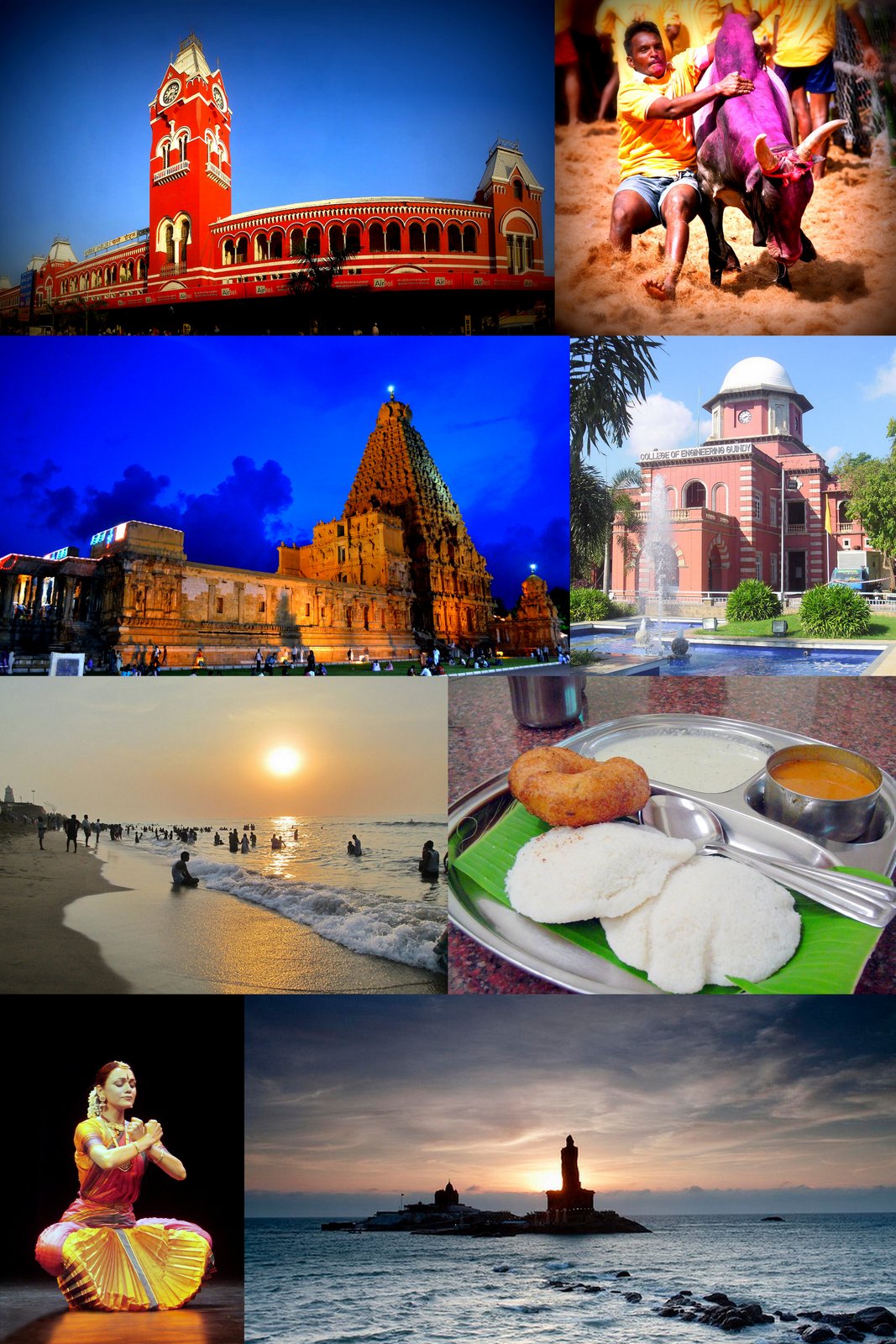
Tamil Nadu is the southernmost state of India and the cultural heartland of the Tamil-speaking Dravidian people. It ranks tenth in area and sixth in population among Indian states, with Chennai serving as both its capital and largest city.
What are Tamil Nadu's powers and role?
Tamil Nadu operates as a major economic powerhouse in southern India, posting a GSDP of roughly ₹27.22 trillion (about US$280 billion) as of December 2023. It also holds cultural authority as the birthplace of Tamil, the first language ever granted classical status in the country.
How does Tamil Nadu's story end?
Tamil Nadu has no narrative ending because it is a living state with more than 5,500 years of unbroken cultural continuity stretching from the ancient Tamilakam era to today. Its story remains an ongoing one, shaped by its language, people, and evolving economy.
Why is Tamil Nadu important?
Tamil Nadu preserves one of the world's longest continuous literary and civilisational traditions, giving it a unique place in Indian and global history. Economically, its per-capita GSDP of around ₹315,220 places it among the more developed regions of the country.
What is Tamil Nadu's official language and why does it matter?
Tamil is the state's sole official language and was the first to be recognised as a classical language in India, underscoring its ancient literary heritage. The language serves as the core of regional identity and unites the Tamil-speaking population across the state.
More in States And Regions 1-15
Spotted an error? Know more?
This is a living reference — every entry is fact-audited, and reader corrections feed straight into our audit queue. Suggest an edit · See this site's audit record